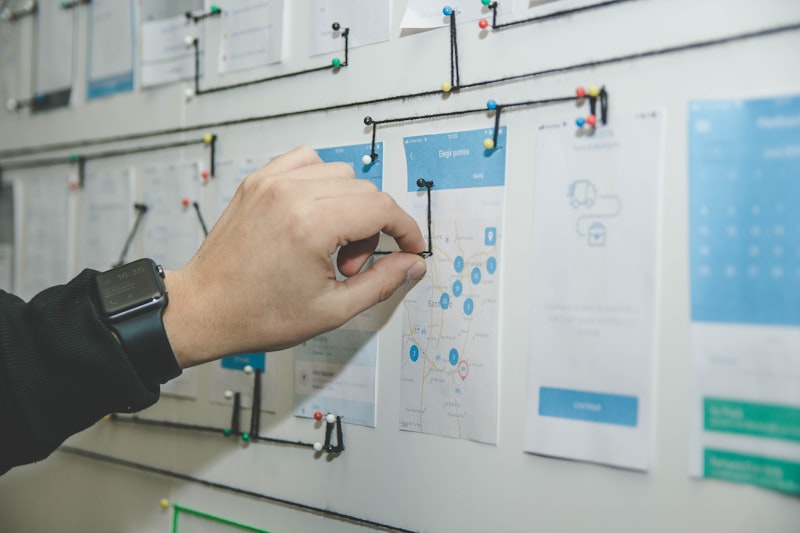
Design thinking emerged from the studios of IDEO and Stanford's d.school as a structured approach to tackling ill-defined problems — the kind where the real question isn't yet clear, let alone the answer. Unlike traditional problem-solving that begins with a solution in mind, design thinking starts by understanding the humans a problem affects. The result is a methodology that has reshaped how companies like Apple, Airbnb, and GE approach innovation.
The framework most widely taught today comes from Stanford's Hasso Plattner Institute of Design, known as the d.school. Their five-stage model — Empathize, Define, Ideate, Prototype, and Test — provides a rhythm that teams can follow iteratively. The stages are not strictly sequential; they feed back into each other. A failed test immediately sends a team back to ideation or even empathy work.
The Five Stages in Detail
1Empathize
The empathize stage is about understanding the people you're designing for. This means observing their behavior, interviewing them in depth, and immersing yourself in their context. The goal is not to project your own assumptions but to genuinely comprehend their experiences, frustrations, and motivations.
d.school recommends three core empathy methods: observing people in their natural environment, engaging them through interviews and conversations, and immersing yourself in their experience through role-play or shadowing. IDEO's field research protocols emphasize the "extreme user" approach — understanding not just average users but those at the extremes of a behavior, because insights from extremes often unlock solutions that help everyone.
2Define
The define stage transforms everything learned during empathize into a clear problem statement — what d.school calls a "point of view" or "How Might We" question. This isn't simply summarizing observations. It requires synthesis: finding patterns across interviews, identifying unmet needs, and framing the right problem to solve.
A well-crafted HMW question is narrow enough to be actionable but broad enough to invite creative solutions. "How might we increase sales?" is too generic. "How might we help first-time home buyers understand mortgage options without feeling overwhelmed?" is specific to a real human experience and immediately generative.
3Ideate
Ideation is the stage where teams generate the widest possible range of solutions. The principle here is divergence before convergence — quantity over quality, deferring judgment, and building on each other's ideas. Techniques include brainstorms, brainwriting, bodystorming (acting out scenarios), and worst possible idea (deliberately generating terrible ideas to break psychological barriers).
IDEO's design teams use "Yes, and..." rules to keep ideation sessions generative. The point isn't to evaluate ideas yet — it's to fill the solution space as broadly as possible.
4Prototype
Prototyping in design thinking means building quick, cheap, rough representations of potential solutions — anything from a paper sketch to a role-play scenario to a physical mock-up. The purpose is externalization: getting ideas out of people's heads and into the world so they can be experienced and evaluated.
d.school teaches that prototypes should be "low fidelity" early — fast and cheap — because high-fidelity prototypes too early create attachment and resist feedback. The motto: "Fail early to succeed sooner."
5Test
Testing involves putting prototypes in front of real users and watching how they interact. This is not a validation stage — it's a learning stage. The feedback from testing often reframes the problem, reveals assumptions that were wrong, and sparks new ideas that weren't considered in the original ideation phase.
Test results feed back into the entire cycle. A failure in testing might mean going back to empathize (did we understand the user correctly?), back to define (did we frame the problem right?), or back to ideation (do we need different kinds of solutions?).
The Science Behind User Empathy
Design thinking's emphasis on empathy isn't just intuitive — it's supported by cognitive science. mirror neurons, first identified in macaque brains in the 1990s and later mapped in humans, appear to enable empathetic understanding by internally simulating observed actions and emotions. When a designer watches a user struggle with a task, their own neural systems for frustration and confusion activate, creating an embodied understanding that pure rational analysis can't replicate.
Research by communication scholar Arthur VanGundy found that teams who conducted genuine empathy research generated 40% more novel ideas than teams using only internal brainstorming — not because they were smarter, but because they had richer raw material to work from.
Real Case Study: Airbnb
Airbnb's Identity Crisis → Growth
In 2009, Airbnb was struggling. Their rental listings looked like classified ads — small photos, poor descriptions, inconsistent formatting. Founders Brian Chesky and Joe Gebbia traveled to New York to meet hosts and guests in person. They discovered that professional photography dramatically improved booking rates. They hired freelance photographers to shoot listings in New York. Booking rates on those listings doubled.
This insight came from empathize work: going to users, understanding their experience, and identifying the real barrier (perceived quality of listings) rather than assumed barriers (price, location, trust). The team scaled professional photography as a service, which became a turning point in Airbnb's growth trajectory. The design thinking process — specifically the empathy and prototype stages — identified a solution no internal brainstorm would have surfaced.
When Design Thinking Works Best
Design thinking excels in three conditions: when the problem involves human behavior and experience, when the problem space is unclear or poorly defined, and when cross-functional collaboration can break down organizational silos. It is particularly powerful in product development, service design, and organizational challenges.
GE Healthcare used design thinking to redesign an MRI machine experience for pediatric patients. By spending time in hospitals watching children react to the intimidating machine, the team identified that the problem wasn't the technology — it was the fear. They created a "海盗船" (pirate ship) themed MRI experience, reducing sedation requirements in children by 30% and scan time by 25%.
When Design Thinking Falls Short
Design thinking has genuine limitations. It is time-intensive and resource-heavy — the empathy and prototype stages require field research, stakeholder interviews, and iteration cycles that move too slowly for crisis situations or fast-moving markets. Organizations have also used it as a veneer for innovation theater, running design sprints without committing to the organizational changes that real implementation requires.
The methodology also tends to undervalue technical constraints. Design thinkers are trained to hold constraints loosely, but engineers and developers must respect physical laws, regulatory requirements, and technical debt. The friction between "imagine anything" and "build this" can cause frustration if not managed carefully.
Additionally, design thinking was developed primarily in consumer product contexts. Applying it to enterprise software, infrastructure decisions, or public policy problems requires significant adaptation. The methodology's emphasis on individual user experience doesn't always translate when problems involve systemic, structural, or political dimensions.
Practical Process: Running Your First Design Thinking Sprint
IDEO's Human-Centered Design Engine
IDEO, the design firm that pioneered many of these techniques, developed a "three-phase" model within design thinking: Inspiration, Ideation, and Implementation. The inspiration phase corresponds roughly to empathize. The ideation phase covers brainstorming and concept development. Implementation covers prototyping, testing, and business model development.
What distinguishes IDEO's approach is the emphasis on "designing for the extremes." By focusing on extreme users — those with the most acute needs, the most experience, or the most unusual behaviors — designers often discover insights that apply broadly. Designing for wheelchair users in airports improved wayfinding for everyone, not just those with mobility challenges.
Common Pitfalls to Avoid
Skipping empathy: The most common mistake is jumping straight to solutions because the problem "seems obvious." When Procter & Gamble redesigned the Swiffer mop, initial internal teams assumed users wanted more features. Actual user research revealed users wanted something simpler and less messy. The final product — a disposable wet pad system — became a billion-dollar franchise.
Groupthink in ideation: Without strict ground rules, brainstorm sessions become dominated by senior voices or loud personalities. Use anonymous idea generation or silent sketching to ensure quieter team members contribute equally.
Testing with the wrong people: Prototypes tested with internal colleagues or friendly users produce useless feedback. Always test with people who represent your actual target users and who will give honest reactions.
Continue Reading